What Group Is Beef Jerky in
 | Look upwards ch'arki in Wiktionary, the free dictionary. |


Orange-marinated beef jerky

Jerky is lean trimmed meat that has been cutting into strips and dried (dehydrated) to foreclose spoilage. Usually, this drying includes the add-on of table salt to prevent bacteria growth before the meat has finished the dehydrating process. The give-and-take "jerky" derives from the Quechua give-and-take ch'arki which means "dried, salted meat".[one] [two] [iii] All that is needed to produce basic "jerky" is a low-temperature drying method, and salt to inhibit bacterial growth.
Modern manufactured jerky is often marinated, prepared with a seasoned spice rub or liquid, or smoked with depression oestrus (usually under 70 °C/160 °F). Store-bought jerky commonly includes sweeteners such as dark-brown saccharide.
Jerky is ready-to-consume, needs no additional grooming and can exist stored for months without refrigeration. To ensure maximum shelf-life, a proper protein-to-moisture content is required in the last cured product.[4]
Many products which are sold every bit jerky consist of highly candy, chopped and formed meat rather than traditional sliced whole-muscle meat.[ commendation needed ] These products may incorporate more fat, but moisture content, every bit in the whole-muscle product, must run across a 0.75 to 1 moisture-to protein ratio in the United states.[5] [ total citation needed ] Chemical preservatives can forbid oxidative spoilage, but the moisture-to-protein ratio prevents microbial spoilage by depression water activeness. Some jerky products are very high in sugar and therefore taste very sweet – different biltong, which rarely contains added sugars.
Grooming [edit]
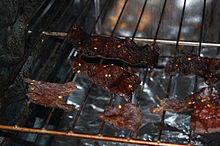

Hasty is made from domesticated animals also equally game animals. Jerky from domesticated animals includes beefiness, pork, goat and mutton or lamb and game animals such every bit deer, kudu, springbok, kangaroo, and bison are also used.[vi] Recently, other animals such as turkey, ostrich, salmon, alligator, crocodile, tuna, emu, horse, camel, and earthworm have entered the market.[7]
Most fat must be trimmed from the meat prior to drying, as fatty increases the chances of spoilage (mod vacuum packing and chemic preservatives have served to assistance forestall these risks). The meat must be dried quickly to limit bacterial growth during the critical period where the meat is not yet dry. To accomplish drying chop-chop without the use of high temperature, which would melt the meat, the meat must be sliced or pressed sparse.
In industrial settings, large low-temperature drying ovens with many heater elements and fans make apply of exhaust ports to remove the wet-laden air. The combination of fast-moving air and low heat dries the meat to the desired moisture content within a few hours. The raw, marinated hasty strips are placed on racks of nylon-coated metallic screens which accept been sprayed with a light vegetable oil to allow the meat to be removed hands. The screen trays are placed closely in layers on rolling carts which are and then put in the drying oven.
Chemical preservatives, such as sodium nitrite, are often used in conjunction with the historical salted drying procedure to prepare jerky. Smoking is the almost traditional method, every bit it preserves, flavors, and dries the meat simultaneously. Salting is the most common method used today, every bit it both provides seasoning to improve the flavour as well as preserve the meat. While some methods involve applying the seasonings with a marinade, this can increase the drying time by calculation moisture to the meat.
Packaging [edit]

Raw meat earlier aridity into jerky
Subsequently the jerky is dried to the proper moisture content to prevent spoilage, information technology is cooled, then packaged in (ofttimes resealable) plastic bags, either nitrogen gas flushed or vacuumed packed. To prevent the oxidation of the fat, the sealed packages often comprise small-scale pouches of oxygen absorber. These small-scale packets are filled with fe particles which react with oxygen, removing the oxygen from the sealed jerky package, and from an opened and resealed unfinished package.
Because of the necessary low fat and moisture content, hasty is high in protein. A 30 g (most one oz) portion of lean meat, for instance, contains well-nigh vii chiliad of poly peptide. Past removing 15 k of water from the meat, the protein ratio is doubled to about 15 m of protein per 30 g portion. In some low moisture varieties, a 30 g serving will incorporate 21 g of poly peptide, and only 1 g of fat. The cost per unit weight of this blazon of jerky is higher than less-dried forms, as it takes xc k of 99% lean meat to generate 30 thou of hasty.
Unpackaged fresh jerky made from sliced, whole muscle meat has been bachelor in specialty stores in Hong Kong at least since the 1970s. The products are purchased by kilograms, and customers choose from 10 to 20 types of meat used to make the product. Some are sold in strands instead of slices. Macau has opened numerous specialty shops also, many of which are franchise extensions of stores from Hong Kong. Compared to the sealed packaged versions, unpackaged jerky has a relatively short shelf life.
This type of jerky has also become very pop in convenience stores in the United states under the name "slab" jerky; it is usually sold in plexiglass containers.
Regulation [edit]
Most nations have regulations pertaining to the product of dried meat products. There are strict requirements to ensure condom and wholesome production of jerky products. Factories are required to accept inspectors and sanitation plans. In the The states, the U.South. Section of Agronomics (USDA) is responsible for that oversight. To comply with USDA regulations, poultry jerky must be heated to an internal temperature of 160 °F (71 °C) for uncured poultry or 155 °F (68 °C) for cured poultry to be considered safe [8] Many European Marriage countries presently prohibit the importation of meat products, including jerky, without additional and all-encompassing customs documentation, and farther inspections.[9]
Availability [edit]

Venison jerky strips prior to drying
Traditional jerky, made from sliced, whole muscle meat, is readily available in the The states, United mexican states and Canada in varying meats, brands and qualities, both as packaged and unpackaged. These products are available in nearly every convenience store, gas station, supermarket, and multifariousness shop in those countries, where at that place is a long history of hasty as a food of the pioneers. A similar, less expensive product is made with finely ground meat, mixed with flavors, then the mush is processed into sparse dried strips. The finished item may be labeled as jerky, but with the qualifier "ground and formed". This product is widely available in general interest stores, such every bit supermarkets and convenience stores. Likewise popular is shredded dry jerky (meat floss) sold in containers resembling snuff or dip. Jerky made in the traditional fashion is too a ubiquitous staple of farmers' markets in rural areas all over North America.
In addition to beingness mutual in the Us, Mexico and Canada, jerky is also gaining popularity in supermarkets, convenience stores and online retailers in Commonwealth of australia, New Zealand, the U.k. and Germany. They are carried by some major supermarkets, and now also smaller stores. In China, in improver to the more traditional forms of jerky, in that location is also a similar product which is usually fabricated from pork called pork chip. A similar product is quite pop in Rome, Italy, and its hinterland: information technology is chosen coppiette and was originally made with horse or donkey[x] meat, just it is now more often than not fabricated with pork. Coppiette are seasoned with ruby pepper and fennel seeds. Coppiette were usually eaten while drinking wine (mostly white) in Roman osterie.
In Tamil Nadu, India, the dish is known as uppu kandam which forms part of authentic non vegetarian cuisine. In kerala (India), it is known equally "idi irachi",'idi'=shredded since dried meat strip is usually shredded earlier frying and 'irachi'=meat. Information technology is normally eaten afterward deep frying rather than having it equally information technology is. In Ethiopia, jerky is called qwant'a. In addition to salt, it is seasoned with blackness pepper and either berbere or awaze.[11] A similar product, biltong, is common in South African cuisine; yet, it differs very much in production process and gustation. In Hausa cuisine, kilishi is a class of dried meat, similar to hasty, that is heavily spiced with peppers.

Jerky carried to ISS aboard STS-118, Endeavour Space Shuttle flight with Earth visible out the big window
Jerky (or products closely related to it) is commonly included in military field rations. Information technology is specially bonny to militaries because of its low-cal weight, high level of nutrition, long shelf life and edibility without further training. Since 1996, jerky has been selected by astronauts as infinite food several times for space flying due to its light weight and high level of nutrition.[12] [thirteen]
Nutrition [edit]
A typical 30 g portion of fresh jerky contains 10–xv g of poly peptide, ane k of fatty, and 0–3 grand of carbohydrates, although some beef hasty tin accept a protein content in a higher place 65%.[14] Since traditional hasty recipes utilise a basic table salt cure, sodium can be a business concern for some people. A xxx one thousand serving of jerky could contain more 600 mg of sodium, which would exist about 30% of the recommended USRDA. Listed in the ingredients, sugar can exist the 2d ingredient listed after beef.[ commendation needed ]
Ch'arki [edit]
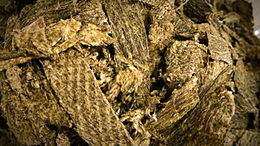

Ch'arki (Quechua for dried, salted meat,[ane] Hispanicized spellings charque, charqui, charquí) is a dried, salted meat product. Andean charqui, made in Republic of peru, Bolivia and Chile, is from alpaca, llama or alpaca-llama cantankerous-breeds. Peru is the globe'south largest producer with approximately 450 tons produced per year. Brazilian charque is made from beef.[15]
The manufacture of charqui principally consists of salting and sun-drying. In some regions, such as in Puno, the meat is sliced before drying; in others, like Cusco, the meat is dried from whole bone-in carcass pieces, known equally 'charqui completo'.[xv]
Information technology was industrialized in charqueadas (in Brazil) or saladeros (in Argentina and Uruguay). In the U.s.a. ch'arki was Anglicised equally jerky.[16] [17]
When encountered past the Spanish, the Inca Empire supplied tampu (inns) along the Inca road system with llama ch'arki for travelers. The Inca used a freeze drying process that took reward of their common cold dry mountain air and strong dominicus.[ citation needed ]
See also [edit]
- Bakkwa – Salty-sweet stale meat product
- Kilishi
- Biltong – Course of dried, cured meat that originated in Due south Africa
- Borts – Mongolian air-dried meat
- Carne seca
- Cecina
- Dendeng – Indonesian spicy meat dish
- Pemmican – Food mix with long shelf life, sometimes used as survival food
- Salt pork – Salt-cured pork usually made from pork abdomen
- Sukuti – Dried meat production from the Himalayas
- Mojama – Andalusian cured tuna delicacy
References [edit]
- ^ a b Teofilo Laime Ajacopa, Diccionario Bilingüe Iskay simipi yuyayk'ancha, La Paz, 2007 (Quechua-Spanish dictionary)
- ^ "Earth trotting: Ecuador". Taipei Times. fifteen July 2006. Retrieved 6 February 2015.
- ^ "Feet in the Trough: Cured Meat". The Economist. 2006-12-nineteen. Retrieved 2007-12-xix .
- ^ Richard J. Epley and Paul B. Addis. "Processing Meat in the Home" (PDF). Minnesota Extension Service.
- ^ USDA Food Standards and Labeling Policy Book, p. 83.
- ^ Delong, Deanna (1992). How to Dry Foods. Penguin Group. p. 79. ISBN1-55788-050-six.
- ^ Waters, Theopolis. "Slumping U.S. meat prices help feed appetite for jerky". U.S . Retrieved 2018-09-eighteen .
- ^ https://www.fsis.usda.gov/wps/wcm/connect/67432999-95e4-4360-a9c9-ddd63276631a/Seminar_Jerky_Guidelines.pdf?MOD=AJPERES
- ^ For example The U.k. department for food and agronomics and food ban all meat imports for personal consumption from the USA. Their data can be searched:Defra search
- ^ "Archived re-create". Archived from the original on 2011-07-22. Retrieved 2010-10-20 .
{{cite web}}: CS1 maint: archived copy as championship (link) - ^ D.J. Mesfin. Exotic Ethiopian Cooking. Ethiopian Cookbook Enterprises, Falls Church, Physician, 2006. p. 31
- ^ "I'd Similar to Meet a Menu, Please". NASA. 2004-05-xiii. Archived from the original on 2004-11-09. Retrieved 2007-01-08 .
- ^ "Infinite Food". NASA. 2004-05-27. Archived from the original on 2004-xi-03. Retrieved 2007-01-03 .
- ^ "Billy Franks Beefiness Jerky - Roast Beef and Mustard (40g)". MeatSnacker. Archived from the original on 12 September 2017. Retrieved 30 March 2015.
- ^ a b Salvá, Bettit One thousand.; Fernández-Diez, Ana; Ramos, Daphne D.; Caro, Irma; Mateo, Javier (January 2012). "Chemical composition of alpaca (Vicugna pacos) charqui". Food Chemistry. 130 (2): 329–334. doi:x.1016/j.foodchem.2011.07.046.
- ^ "CHARQUI". Etimologías de Chile - Diccionario que explica el origen de las palabras . Retrieved Aug 27, 2020.
- ^ "Archived copy" (PDF). Archived from the original (PDF) on 2010-07-01. Retrieved 2012-03-29 .
{{cite web}}: CS1 maint: archived re-create every bit title (link)
External links [edit]
- Commercial Item Description (CID): Cured Meat Snacks Archived 2008-10-07 at the Wayback Machine U.S. Dept. of Agriculture specification
- U.S. Dept. of Agriculture: Jerky and food safety fact sheet
- Accurate Beef Jerky from Outback Commonwealth of australia (Nive Beef)
Source: https://en.wikipedia.org/wiki/Jerky
0 Response to "What Group Is Beef Jerky in"
Enviar um comentário