What Type of Art Was Created by the Group Die Brucke and Der Blaue Reiter?

The beginning of the 20 th century brought with it revolutions and advancements in the way art was viewed and created. Der Blaue Reiter or The Blue Rider Group was founded in Munich, Germany in response against "traditional" methods of art. Their art explored the relationships between art, music, color, and spiritualism. Even though the grouping was short-lived their fine art and ideas contributed to the development of German Expressionism.
The Start Of Der Blaue Reiter
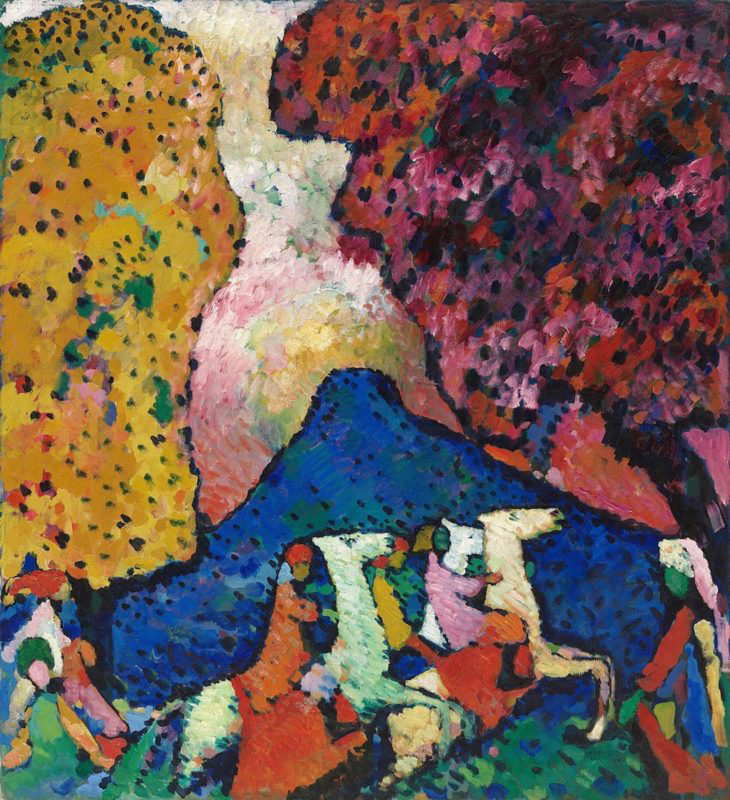
The group was founded by a alloy of Russian emigrants and native German language artists in 1911. Some of the grouping's most recognizable names include Wassily Kandinsky and Franz Marc who were the principal members that shaped the grouping'south overall vision. Other artists include Alexej Von Jawlensky , Gabriele Münter , Marianne Von Werefkin , August Macke , and Paul Klee . They formed the group in rejection of another German artistic movement, Neue Künstlervereinigung München (Munich New Association of Artists). They strived to create a new wave of modern art that separated themselves from the conventional and conformist art of their predecessors. They became interested in creating art that expressed emotions rather than depicting literal scenes. While each private artist approached subject affair and technique differently they all shared the aforementioned ideas of creating art as a connection to the spiritual through the use of color.
The Meaning Behind The Name Der Blaue Reiter
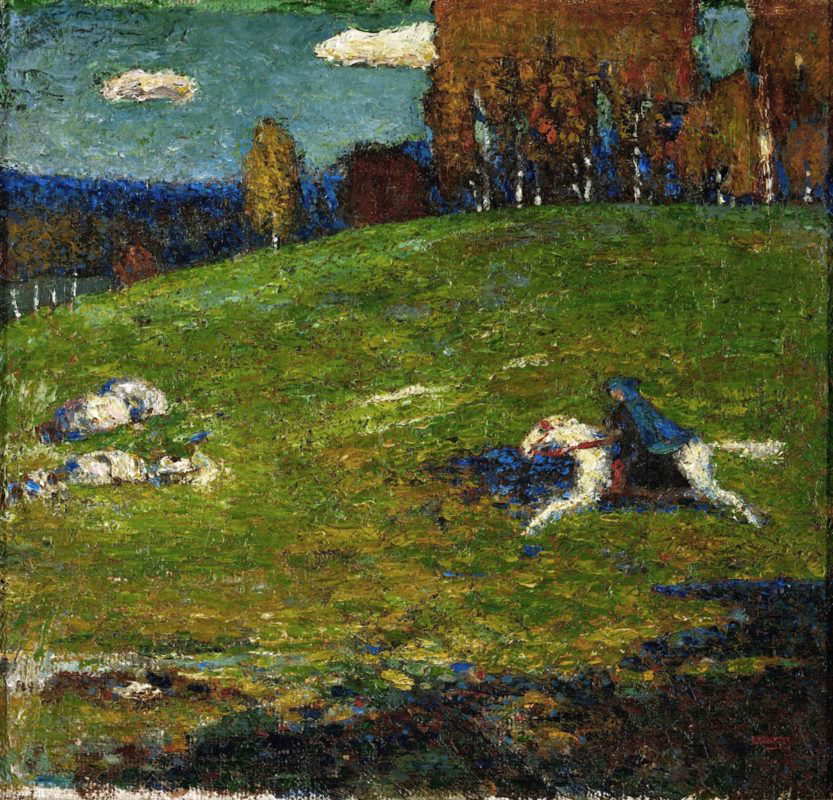
The naming of the group can be simplified in that Marc liked horses and Kandinsky liked riders, so together they created the proper name Der Blaue Reiter. However, in that location is more substance to the reason why horses, riders, and the color meant so much to this grouping and contributed to their name and lasting identity.
The painting The Blue Rider is seen as the painting that became the basis for the proper noun of Der Blaue Reiter group. Kandinsky painted the image in 1903, and it is one of the showtime paintings where he transitioned into a more abstract style. The passenger in the proper noun came to symbolize the transition from the physical world to the spiritual. This thought is from the medieval Christian warriors and knights, such as Saint George, which inspired the group. The story of Saint George slaying a dragon plays a major role in the early works of Kandinsky. To them, this represented the decease of the one-time and the nascence of a beginning. The passenger is the carrier of a divine awakening and a rebirth of fine art. The members of Der Blaue Reiter saw the materialism of their age every bit a block against the spiritual understanding of the mind and soul.
Are you enjoying this article?
Sign upwards to our Complimentary Weekly Newsletter
Delight cheque your inbox to actuate your subscription
Thank y'all!
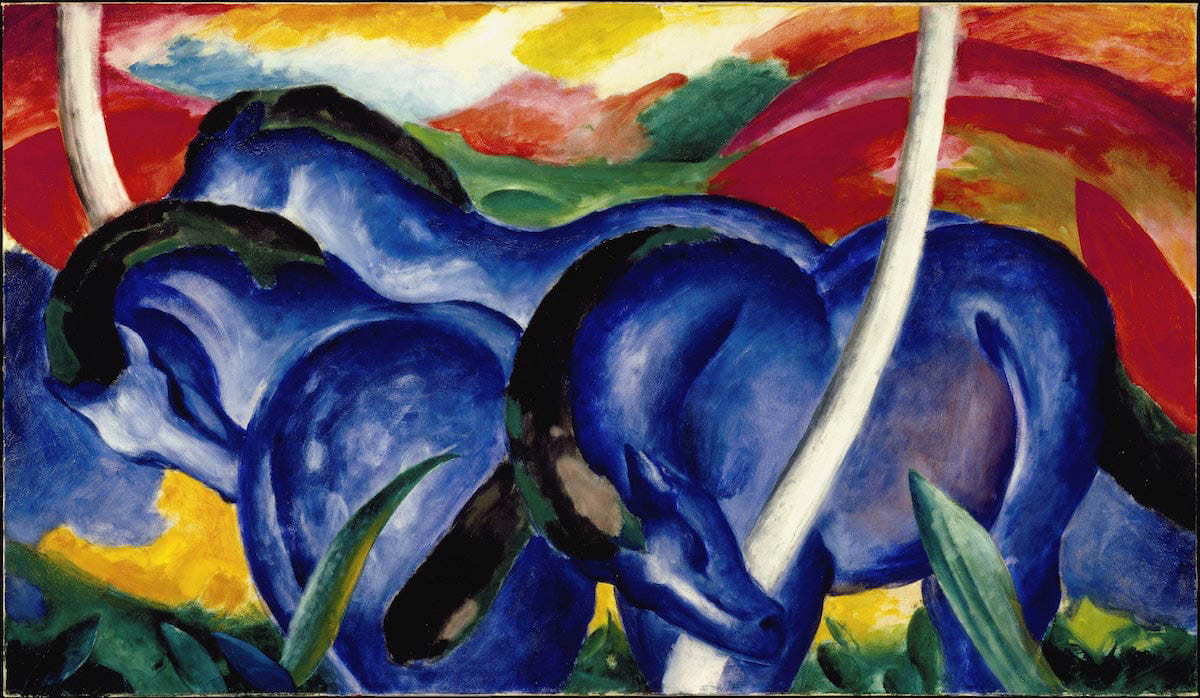
The color blue became the literal manifestation of the transcendent and divine that these artists used in their art. Blue was seen equally the most spiritual and calming color that is consistently seen in a diversity of the group's artworks. Blue was frequently used in conjunction with Franz Marc's horses every bit together they represent the traveling of the material globe to a more than heavenly one. Bluish is too connected to masculinity while yellow was more than feminine. Crimson represented the physical and natural world compared to the otherworldliness of the colour bluish. The combination of blue and the rider represents the battle betwixt practiced versus evil. To them, the evils of the early 20 thursday century were modernistic technologies, sciences, and urban industrialism.
The Almanac Of Der Blaue Reiter

The "Blaue Reiter" Almanac is a drove of essays, illustrations, and musical scores that has become the basis for the grouping's objectives. On the cover of the volume is the group'south emblem of Saint George. The first edition included 1200 copies with l deluxe editions that include woodcuts by Wassily Kandinsky and Franz Marc. The limited edition woodcuts titled (Bogenschütze) Archer , by Kandinsky; and Fabeltier (Fantastic Creature) , past Marc simply appear in the first edition. The group just published this commencement volume as the Start World War interrupted plans for a second. The volume also contains musical scores by Arnold Schönberg and Alexander Scriabin with Schönberg contributing an essay too as sheet music for three compositions. Kandinsky'due south Yellow Sound (Der gelbe Klang) is besides included. The volume contained not only images of work past the group, simply other artists including Pablo Picasso , Vincent van Gogh , and Henri Matisse .

There are too images of Medieval, Renaissance, folk-art, and not-European works of art. This included African statues, Asian ink drawings, folk fine art, and reverse glass paintings from Bavaria. The untrained artists and folk artists whose art would take been chosen "primitive" during that fourth dimension inspired their art. The elementary abstraction of forms and subject matter pb members of the group to create imagery that deflected more than and more than from the natural world. What makes this book important is the collaborative effort that was put into its making. By placing images of art from a wide range of cultures, artists, musicians, and critics, it showed that all art could live simultaneously in one space. It shows that there is room for all types of fine art and how much each one influences the other.
The Influence Of Color

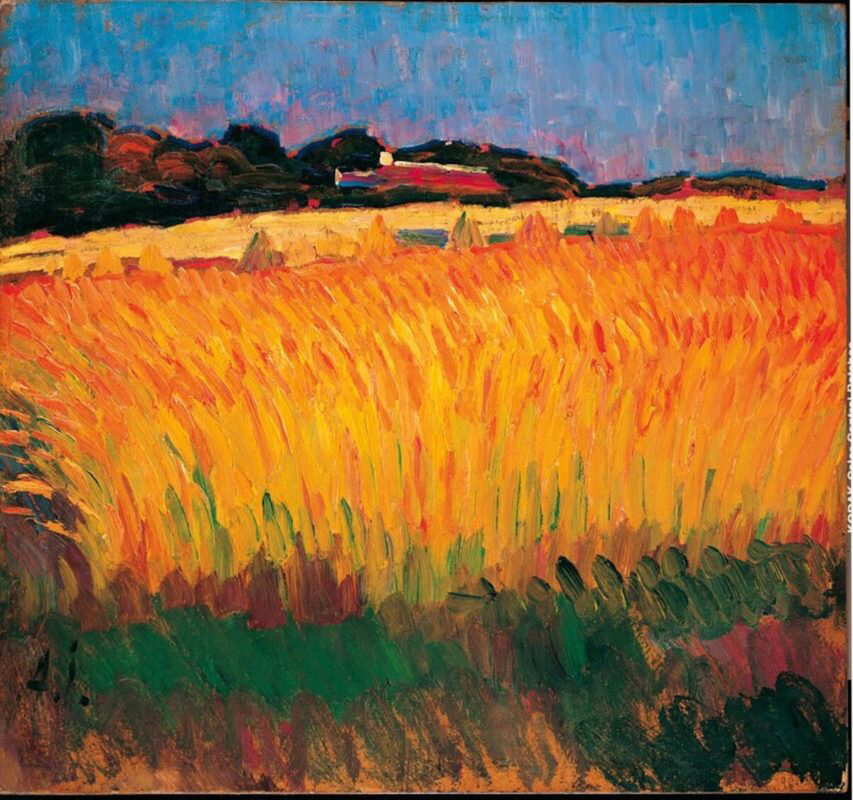
Colour played a major function in the works of Der Blaue Reiter. Equally seen in the painting above, in that location is a articulate stardom between the applications of colour betwixt different members in the same grouping. Fauvism has links to the Der Blaue Reiter group peculiarly with Gabriele Münter and Alexej Von Jawlensky. Similar to a coloring volume, they would place color within thick, nighttime lines and then it creates contrast and dimension. Jawlensky'due south portraits demonstrate this connection between color and emotion. He focused primarily on the heads of figures rather than full-body portraits. He used raw bright colors in order to showcase how color can become the essence of 1'southward being.

Another inspiration came from the works of Robert Delaunay and Orphism , which would inspire August Macke and Franz Marc. They were struck by Delaunay's usage of color where it is fractured into fragments of color. Rhythm plays a huge role in this, as Delaunay believed that colors moved before one's vision just as much equally the natural world. This influenced Macke to paint forms that are cut into sections with very distinct angular shapes. His subjects include women in department stores, walking in parks, or groups of women in activity to which he applies this technique. Compared to Alexej Von Jawlensky, Macke uses very singled-out shapes that are nearly cubist while Jawlensky uses more expressive brushstrokes freely.
Colour pushed the boundaries of expressionism as artists used it to display the innermost spiritual feelings they felt while they painted. The usage of colors became freer and less subjected to the dullness of reality. Information technology pushed the outer limits of what was considered appropriate for traditional painting. Color also played major importance for Kandinsky who used it in conjunction with expressing emotions with sound.
The Color Of Music
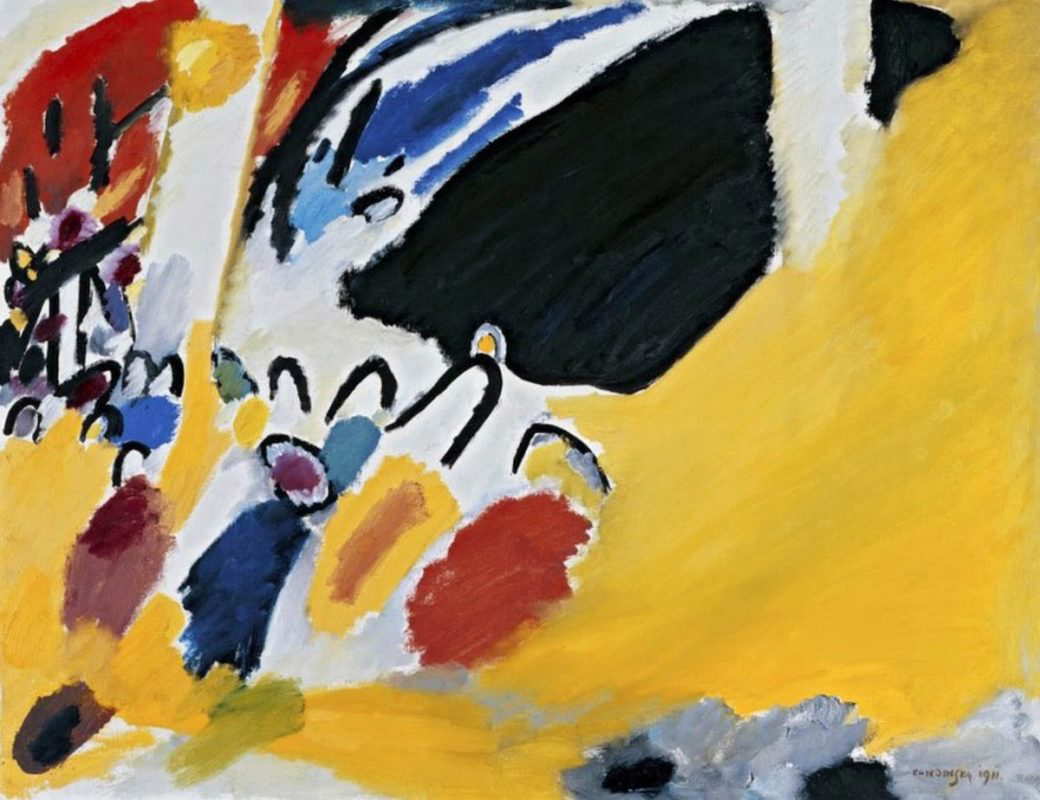
Music and its connexion to color play a cardinal function in Wassily Kandinsky's abstract paintings. Synaesthesia, the power to hear, taste, or smell color, is a concept that introduced Kandinsky to using color as a representation of physical senses. Each colour also represented unlike sections of an orchestra and together these colour combinations create a color symphony. This was also impactful on the artist Paul Klee and his development into abstract art. Music was also a large inspiration for him as both he and Kandinsky studied music in their youth.
Kandinsky based colors with specific emotions and even instruments. His paintings are symphonies of color with each colour eliciting a different emotional response. Yellowish is an earthly color, and the brighter the yellow the more cluttered and shrill feelings information technology promotes. Bluish is calming and heavenly which helps to atmosphere down the yellows. Reds are powerful and dynamic which symbolize deep drums or the crescendo of trumpets. Green is the calmest colour, reflecting the soft tones of a violin. Violets are melancholy and are similar to the saddening music of horns or bagpipes. Finally, black represents the finale of a musical piece while, in contrast, white is when all the other sounds go mute.
Although his paintings may seem spontaneous and appear equally if Kandinsky completed it right on the spot, this is actually false. Just like a composer arranging notes on a musical score, Kandinsky painted every bit if the notes were paint and the canvas was sheet music. Every colour placement was intentional and it would sometimes take years for him to complete these types of musical paintings.
The Women Of Der Blaue Reiter

Within Der Blaue Reiter at that place were female person artists including Marianne Von Werefkin, Gabriele Münter, Natalia Goncharova, and Clotilde von Derp. Both Werefkin and Münter played critical roles regarding the style and advancements they made for female person expressionist artists. Both of these artists were partners with other members of the group: Werefkin with Jawlensky and Münter with Kandinsky during this time. Werefkin would even ready back her ain career and champion Jawlensky as an artist, fifty-fifty creating an exhibition for him. They were females within a group of men and they suffered the confines of existence women. However, they were still able to produce piece of work that paved mode for future expressionist women artists.
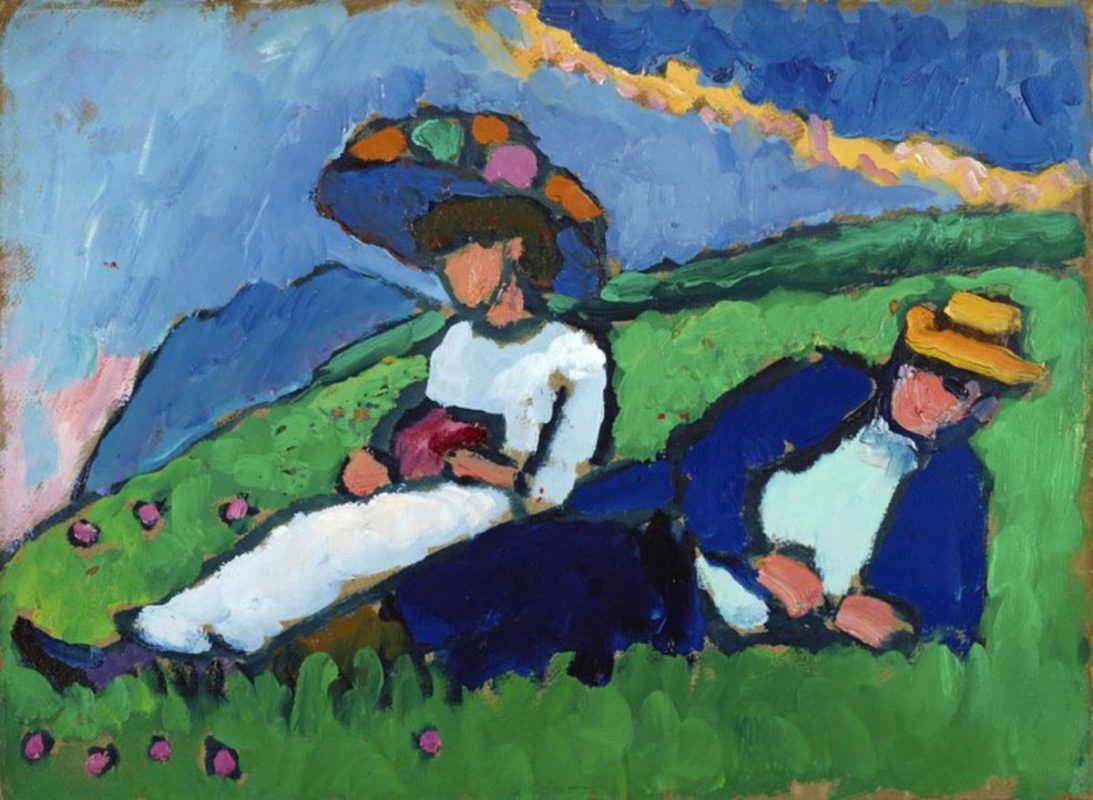
Gabriele Münter'southward work is characterized by her use of bold colors and outlining her subjects with black, thick lines. Her paintings accept a compacted perspective that registers as flat to the viewer. She focuses on the color composition of her subjects filling them with vibrant colors similar to the French Fauvists. Whether it is portraits or landscapes, Münter'south works take simplistic shapes that are reflective of her inspiration from traditional folk art from Bavaria and even children's paintings. She never went completely abstract like Wassily Kandinsky, just rather created figurative art that nonetheless resembled reality. This move towards a simple and child-similar appearance is representative of the group'south desire to go back to creating art that was primitive. She likewise created still-lives with imagery of traditional Bavarian artifacts or religious iconography.

Marianne Von Werefkin's art would focus on images of women and the impoverished in her works. Her piece of work shows the departure in how women were represented during the offset of the 19 thursday century. Compared to her contemporaries, she depicted women working and as hunching back against a backdrop of streams of color. Her use of colour and expressive brushstrokes were influences of Edvard Munch and Vincent Van Gogh who likewise used color to limited the soul. She used a darker color palette with deeper tones of reds and blacks particularly for the article of clothing of women. Werefkin showcases the women who were laborers and in the workforce during the rise of industrialism. Her paintings combined the harsh realities of women during her era with the supernatural splendor in her landscapes.
Der Blaue Reiter's Simply American Member

Albert Bloch is an American painter who moved to Germany in 1909. He joined the Der Blaue Reiter group in 1911 after Wassily Kandinsky and Franz Marc visited Bloch's studio. He was the only American artist who joined the grouping. During his stay in Germany, he adult his own style just as the rest of the members did. He frequently used images of dancing harlequins, clowns playing instruments too equally performing Pierrots. This was Bloch's estimation of how ane could see music in a visual fine art class. Compared to other members of the group, Bloch is not as widely known or recognized for his work in mod fine art. He somewhen moved to Kansas where he taught at the University of Kansas until his retirement.
The painting above is an case of Bloch'south work and his connection to Der Blaue Reiter. His However Life III has no visible foreground or background and instead Bloch represents objects floating seemingly in midair. They correspond the blending of boundaries betwixt the spiritual versus physical worlds. The bananas and other fruit seem to be encased in their own auras giving life to seemingly inanimate objects. His lines are very fluid and wavy which also leans to a more than spiritual representation of a still life. He ever retained the style and philosophy of Der Blaue Reiter even after its ultimate end.
The End Of Der Blaue Reiter
The showtime of the Outset World State of war was finer the finish of the grouping. The war engulfed Europe and the members of Der Blaue Reiter. Russian members of the grouping including Wassily Kandinsky, Alexej Von Jawlensky and Marianne Von Werefkin were sent dorsum to Russian federation considering of their nationality. Both Franz Marc and August Macke were drafted into the German army where, unfortunately, they both were killed.
Afterward Jawlensky moved to Switzerland and in 1924 he created the grouping Die Blaue Vier (The Blue Four) that included Paul Klee, Lyonel Feininger and Kandinsky. Bloch returned to the United States at the end of World War I where he started a career in didactics. About of the works that he created in Europe were destroyed during the bombings of World War II. He only brought back a few of his Europea paintings. They are now only shown in his ain personal records, which include photographs of the lost paintings.
During Earth State of war Ii, modernistic fine art became a target of the Nazi regime during the 1930-40s where information technology was considered degenerate and constitute to be an crime to the regime. Münter connected to create mod art during this fourth dimension fifty-fifty though she faced backlash and restrictions. While the Nazis would attempt and confiscate artworks she hid her paintings equally well every bit those of Kandinsky and her other fellow Der Blaue Rider members' paintings in her own home in Murnau. During the Nazi authorities Jawlensky, Klee, and other members of the group's art was taken and placed in the Degenerate Art exhibition in 1937.
Source: https://www.thecollector.com/der-blaue-reiter/
0 Response to "What Type of Art Was Created by the Group Die Brucke and Der Blaue Reiter?"
Enviar um comentário